
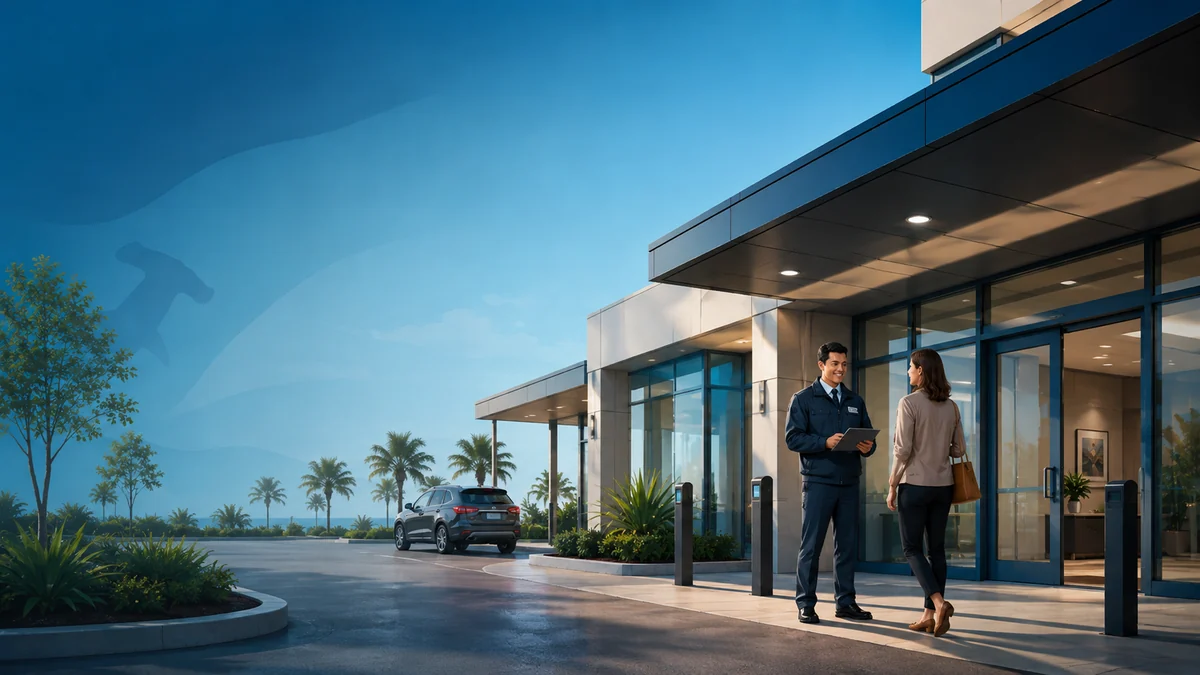
What does a professional unarmed security guard actually do?
For a well-designed account, the answer should be specific. A security officer is not simply present; the officer is assigned defined responsibilities that support the client's security, safety, access, customer-service, and documentation objectives.
Those responsibilities vary by property. A warehouse gate officer has different priorities from an HOA gatehouse officer, a construction-site guard, a commercial lobby officer, or a fire-watch officer. But effective assignments usually share several core functions.
1. Maintain a visible, professional security presence
Visibility matters because it tells employees, residents, customers, vendors, and visitors that the property has an organized security process.
A professional presence includes more than a uniform. Officers should understand:
- where they are expected to be;
- when patrols are required;
- how to interact with the public;
- what behavior must be documented;
- when to contact a supervisor, client representative, emergency service, or other designated resource.
Visibility is most useful when it is connected to a purpose. A guard should know what the post is intended to accomplish.
2. Support access control
Many unarmed-security assignments are fundamentally access-management assignments.
Depending on the site, an officer may:
- verify visitor authorization;
- check employee or contractor credentials;
- maintain visitor or vehicle logs;
- direct deliveries;
- monitor gates or entrances;
- issue temporary passes under client procedures;
- identify access exceptions;
- contact an authorized representative when information does not match.
The officer should not invent access rules. The client and security provider should establish them in written security post orders.
For sites where access is a primary concern, review Hammerhead's access-control security services.
3. Observe and report unusual conditions
Observation is one of the most important functions of an unarmed officer.
That can include noticing:
- doors that should be secured;
- unusual vehicle activity;
- people in restricted areas;
- damaged fencing or lighting;
- unsafe conditions;
- suspicious behavior;
- fire or life-safety concerns;
- water leaks or property damage;
- unusual activity during overnight hours.
The officer's role should be defined by the site, applicable law, company policy, and post orders. Good security programs emphasize early recognition, communication, and documentation rather than improvisation.
4. Conduct purposeful patrols
Patrols should not be random walking with no objective.
A useful patrol plan identifies areas that matter, such as:
- doors and gates;
- parking lots;
- loading docks;
- perimeter areas;
- common spaces;
- construction materials or equipment;
- amenities;
- fire-watch checkpoints;
- areas with a history of problems.
The frequency and route may vary so the pattern is not unnecessarily predictable, but the underlying expectations should still be documented.
Read more about randomized security patrols.
5. Provide accurate activity and incident reporting
Clients should know what occurred during the hours they purchased.
Professional reporting may include:
- daily activity reports;
- patrol records;
- access exceptions;
- incident reports;
- photographs when appropriate;
- supervisor inspections;
- shift handoffs;
- escalation documentation.
A useful report answers practical management questions: What happened? What did the officer do? Who was notified? Is follow-up needed?
Hammerhead uses structured reporting and oversight to make security activity more visible to management. See Security Reporting & Oversight.
6. Communicate problems through a defined escalation chain
An officer should know exactly what to do when something falls outside normal operations.
A site's escalation plan may distinguish between:
- routine client questions;
- access disputes;
- maintenance concerns;
- suspicious activity;
- medical emergencies;
- fire/life-safety issues;
- criminal activity;
- threats or workplace-violence concerns.
This is one reason a security company's supervision and dispatch structure matters. The officer should not be isolated from support.
OSHA advises employers to assess their workplaces for violence-related hazards and, where necessary, incorporate prevention measures into a broader workplace-safety program. Its Workplace Violence resources can help organizations think about risk factors, training, and prevention programs. A contract security officer can support a site plan, but the employer remains responsible for the broader workplace policies and controls applicable to its operation.
7. Provide professional customer service
In many environments, the security officer is one of the first people a visitor encounters.
That is especially true in:
- residential communities;
- corporate offices;
- commercial buildings;
- hospitality properties;
- reception areas;
- visitor gates.
Professional security and good customer service are compatible. Officers can enforce a client's access procedures while remaining calm, respectful, clear, and helpful.
Read Why Great Security Is Great Customer Service for more on that approach.
8. Understand the limits of the assignment
Clients should be cautious of vague promises that a guard will “handle anything.”
A professional provider should define the role realistically. Unarmed officers are not substitutes for police, firefighters, medical professionals, maintenance technicians, or client management. Their job is to perform the contracted security responsibilities, observe conditions, communicate appropriately, and follow established procedures.
Clear limits reduce confusion and help officers make better decisions.
9. Stay prepared for shift changes and handoffs
Security is continuous even when individual officers change.
A good handoff process should address:
- open incidents;
- unusual activity from the prior shift;
- keys or equipment;
- expected visitors or contractors;
- temporary instructions;
- outstanding client concerns;
- changes to post orders.
Poor handoffs create avoidable information gaps.
10. Know the site—not just the job title
The strongest officer is one who understands the specific property.
Before or during deployment, officers should be familiarized with the site's:
- post location;
- important entrances;
- client contacts;
- emergency procedures;
- reporting process;
- patrol expectations;
- restricted areas;
- relief requirements;
- communication tools.
This is why effective contract security should be designed at the site level, not treated as a generic body placed in a chair.
What clients should expect from a professional security provider
The officer is only one part of the service. Clients should also evaluate the operating system behind the officer.
Ask whether the provider has:
- scheduling safeguards;
- call-off replacement procedures;
- supervision;
- training and licensing controls;
- written post orders;
- incident escalation;
- client reporting;
- quality reviews;
- a process for correcting performance problems.
If you are comparing companies, our guide to choosing the right unarmed security provider can help frame the evaluation.
Build the post around the property
The best security guard program is specific enough that both the client and the officer know what success looks like.
Hammerhead Security provides professional unarmed security guard services for warehouses and distribution centers, residential communities, commercial properties, construction sites, access-control posts, events, fire-watch assignments, and other client-specific needs.
To discuss coverage for your property, request a proposal or review our Security Services.